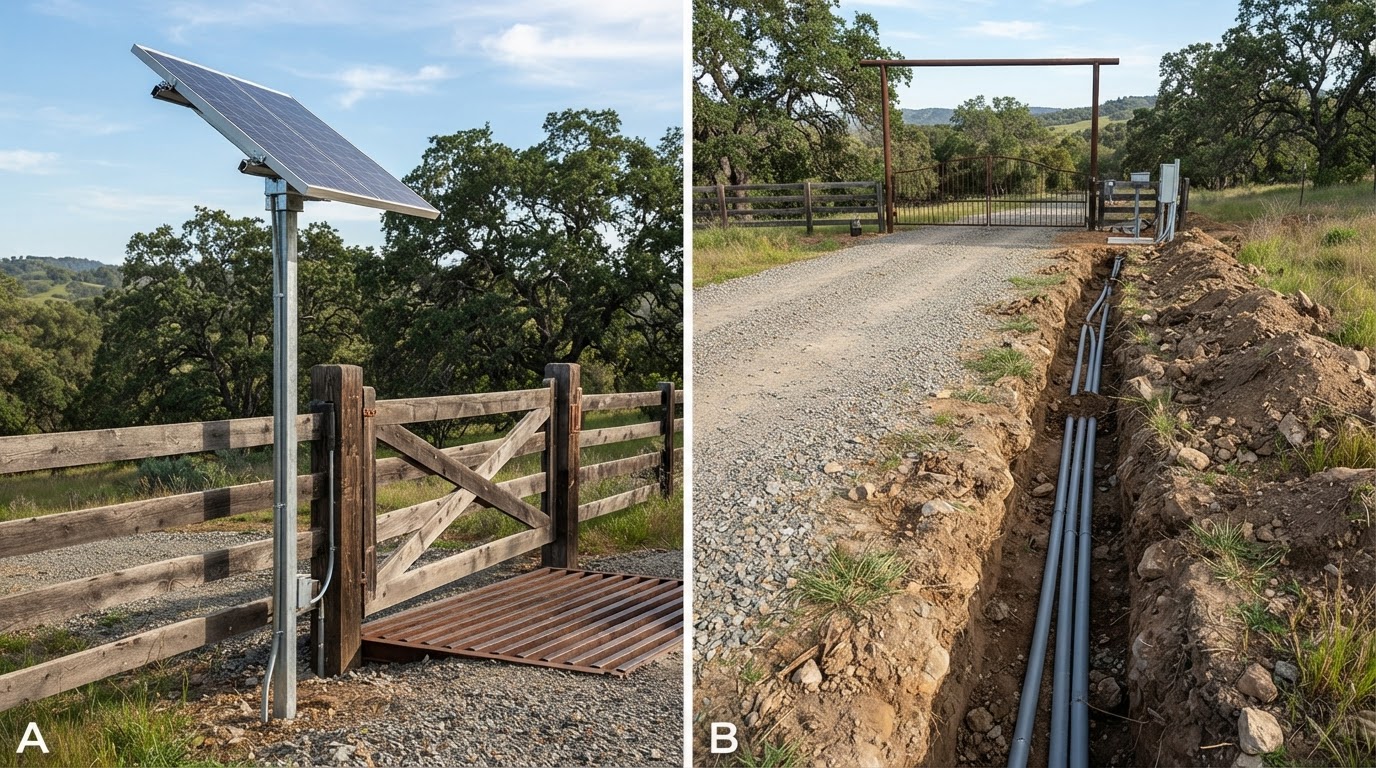
San Antonio Automatic Gates: Solar vs. Hardwired Gate Openers
Every automatic gate needs power, and there are two ways to get it there: run a line from the house, or put a solar panel at the gate. This guide from San Antonio Automatic Gates explains how each works, what each costs to install and keep up, and how to tell which one fits your gate in San Antonio and the Hill Country.
Monday to Saturday, 7:00 AM to 7:00 PM
Get a Free Gate Quote
Last updated: November 19, 2026
Solar vs. hardwired at a glance
| Hardwired | Solar | |
|---|---|---|
| Power source | A line from your electrical panel or a nearby outlet | A panel charging a battery at the gate |
| Install cost | Low if power is close, high if it's far | Usually lower when power is far away |
| Heavy use | Handles lots of cycles a day | Limited by panel and battery size |
| Power outage | Needs a backup battery to keep working | Keeps working, since it already runs on a battery |
| Upkeep | Backup battery replacement | Battery replacement, panel cleaning, watching for shade |
| Accessories | Plenty of power for intercoms and cameras | Every accessory has to be counted in the system size |
How does a hardwired gate opener work?
A hardwired opener gets power from your home's electrical system. A circuit runs from your panel, or from a nearby outlet, through buried conduit to the gate. Most modern residential openers turn that power into low-voltage DC and run off a battery that the house power keeps charged. That's good, because the battery acts as a backup when the power goes out.
New wiring has to be done the right way. The City of San Antonio requires licensed trade contractors for new electrical work on homes, and other cities have similar rules. Trenches need to be deep enough, conduit has to be the right type, and the circuit has to be sized for the opener and any accessories.
How does a solar gate opener work?
A solar opener runs on a battery at the gate. A panel on a post charges the battery during the day. A charge controller keeps the battery from overcharging. The opener and any keypads or intercoms pull from that battery around the clock.
The key word is sizing. The panel has to make enough power, and the battery has to hold enough, to cover every open and close plus everything that draws power all day and night. And it has to do that in December, not just in June. See our solar gate openers service for how we size a system.
When is hardwired the better choice?
- Power is close to the gate, like a garage, barn, or outlet nearby.
- The gate opens and closes many times a day.
- You want a video intercom, cameras, lighting, or heaters at the gate.
- The gate sits in heavy shade.
- The gate is large and heavy and needs a strong operator.
When is solar the better choice?
- The gate is a long way from power.
- Trenching would cross a paved drive, rock, or a creek.
- The property has no power at the gate yet, like raw land or a ranch entrance.
- The gate opens a moderate number of times a day.
- The gate spot gets good sun most of the day.
- You want the gate to keep running through a power outage.
What about power outages?
Long outages do happen here. During Winter Storm Uri in February 2021, Texas Public Radio reported that about 400,000 San Antonio homes and businesses lost power.
Texas Public Radio reported that nearly 50% of the San Antonio area lost power during the February 2021 winter storm and energy crisis, and that about 400,000 homes and businesses lost power throughout it.
Source: Texas Public Radio, Almost Half Of San Antonio Lost Power During Winter Storm
A solar opener doesn't care if the grid goes down, as long as the battery has charge. A hardwired opener with a good backup battery keeps working for a while, then stops when the battery runs out. An opener with no battery stops right away. No matter which one you have, a manual release lets you open the gate by hand. Know where yours is.
How does San Antonio heat affect each one?
Heat is hard on batteries, and both systems use them. A battery in a closed metal box in the afternoon sun wears out faster. On solar systems, the battery does more work every day, so heat shortens its life more. We place battery boxes for shade and airflow and use batteries made for outdoor use. Plan on replacing the battery every few years either way.
How do the costs compare?
The install cost depends mostly on distance. A short trench to a nearby outlet is cheap. A trench hundreds of feet long, especially through rock or under a driveway, can cost more than the opener. Solar adds the cost of a panel, a bigger battery, and a charge controller, but skips the trench. Over time, solar also has more battery upkeep. Angi notes solar or battery systems may need maintenance and battery replacement costing $50 to $200 a year. See the automatic gate installation cost guide.
Can you switch later?
Many low-voltage openers can be charged either way, so switching from solar to hardwired later, or the other way around, is often possible. Older AC openers usually can't run on solar. If you think you might add power to the gate later, like when you build a barn, we can run empty conduit now to make it easier.
Solar vs. hardwired FAQs
Not sure how to power your gate?
Call or send a few details. We'll tell you which option fits.