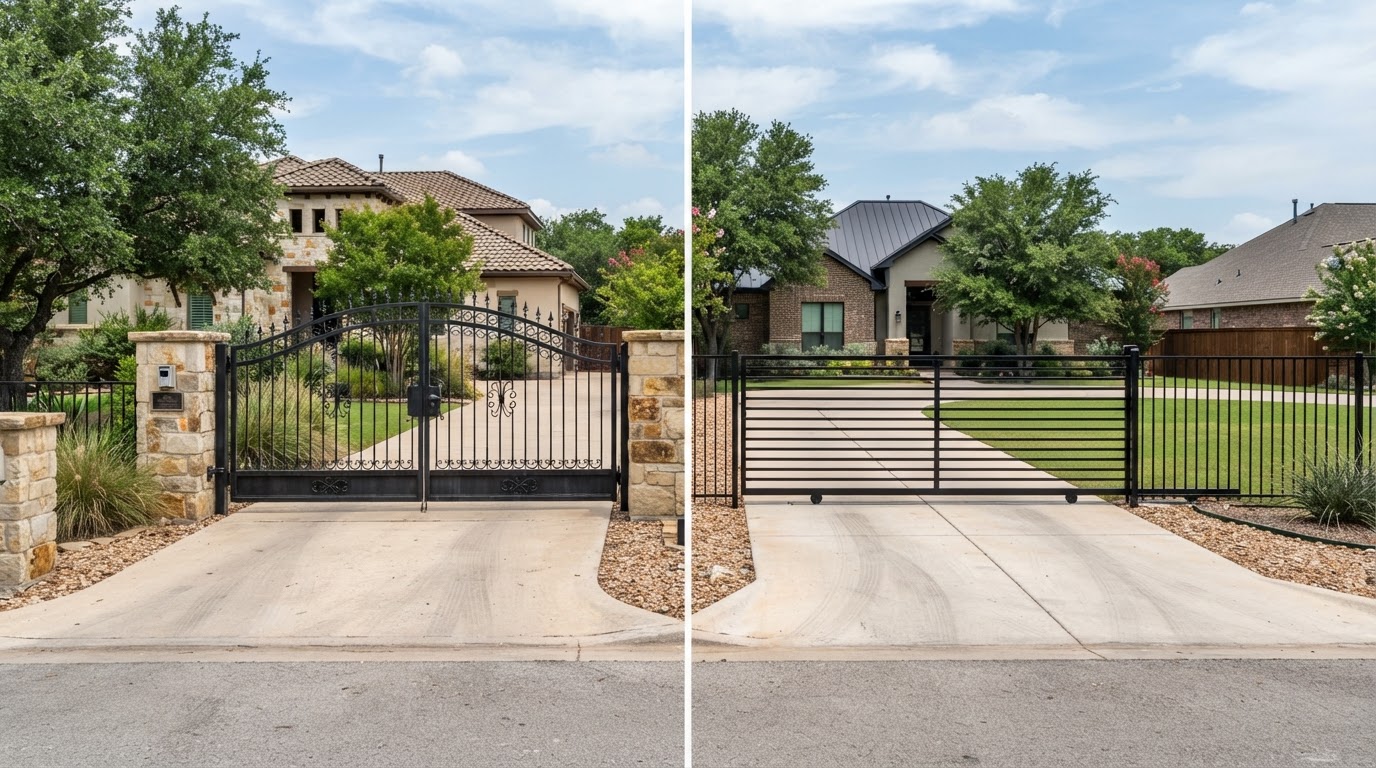
San Antonio Automatic Gates: Swing Gate vs. Slide Gate for Your Driveway
Swing gates and slide gates are the two main types of automatic driveway gates around San Antonio. This guide from San Antonio Automatic Gates explains how each one works, how much space they need, how slope and wind change things, and how to tell which fits your driveway.
Monday to Saturday, 7:00 AM to 7:00 PM
Get a Free Gate Quote
Last updated: November 19, 2026
Swing vs. slide at a glance
| Swing gate | Slide gate | |
|---|---|---|
| How it moves | Opens like a door on hinges | Rolls sideways along the fence |
| Space needed | Room on the driveway for the gate to swing | Open fence line beside the opening, about as long as the gate |
| Sloped driveway | Can hit the ground if the drive rises | Handles slopes well |
| Single or double | Single panel or matching pair | Usually a single panel |
| Opener | Arm or linear actuator on each panel | Pad-mounted operator with rack or chain |
| Speed | Double gates can open quickly | Long gates take a little longer to clear |
| Look | Classic, works with arched tops | Clean, works with long straight lines |
How do swing gates work?
A swing gate hangs on hinges on a post or column and opens like a door. Most driveway swing gates open into the property, away from the street. A wide opening is often split into two panels that meet in the middle. Each panel gets its own opener arm, and the two run together.
Swing gates are popular because they look classic and fit most driveways. They work best when the drive is fairly flat behind the gate and there's room for the panels to swing without hitting cars, walls, or landscaping.
How do slide gates work?
A slide gate rolls sideways along the fence line. Some roll on wheels along a track set in the drive. Others are cantilever gates that hang on rollers mounted on posts beside the opening, so nothing sits on the ground in the drive. An opener on a concrete pad drives a gear along a rack on the gate, or pulls a chain.
Slide gates need open space along the fence on one side, about as long as the gate itself. They're a strong choice on sloped drives, short setbacks, and spots where a swinging gate would block something.
Which one fits a sloped driveway?
This is the question that settles it most often. If the driveway rises behind the gate, a swing gate's bottom edge can hit the ground as it opens. There are fixes, like raising the gate, stepping the bottom, or using hinges that lift the gate as it swings, but they have limits.
A slide gate travels along the fence line, not over the drive, so the drive's slope doesn't get in its way. That's why we put a lot of slide gates on the hilly lots around Helotes, Boerne, and the north side.
What about wind?
Wind matters more than people think. A solid wood or privacy gate catches wind like a sail. On a swing gate, wind pushes on the whole panel and strains the opener and hinges. On a slide gate, wind pushes sideways on the gate, but the gate moves along the fence instead of into the wind.
If you want a solid privacy gate in an open spot, a slide gate or a heavier swing opener may be needed. A gate with open pickets lets wind through and is easier on any opener.
Which one costs more?
Neither type is always cheaper. Angi lists swing gates at about $1,000 to $6,000 and sliding gates at about $1,500 to $5,000, and those ranges overlap a lot. A double swing gate needs two opener arms. A slide gate may need a concrete pad, a track, or cantilever rollers. The site and the gate design usually matter more than the type. See the automatic gate installation cost guide.
Safety on swing and slide gates
Both types can hurt someone if they're not set up right. The places where people get caught are different, so the safety setup is different too.
- Swing gates: the danger zones are the hinge side, where fingers can get pinched, and the arc the gate swings through.
- Slide gates: the danger zones are the leading edge, the gap between the gate and the post it slides past, and the openings in the gate itself.
Gates meant for automation are supposed to meet the ASTM F2200 construction standard, and openers are built to the UL 325 safety standard. For slide gates, that includes screening so a hand can't reach through the gate as it rolls past a post. We set up photo eyes and edge sensors for the type of gate you choose.
How do you choose?
- Look at the slope behind the gate. If it rises, lean toward slide.
- Look at the space. Room to swing in? Swing works. Open fence line on one side? Slide works.
- Think about wind and privacy. Solid gates in open spots do better as slide gates or with heavier swing openers.
- Think about the look. Arched double gates are swing gates. Long straight lines suit slide gates.
- Check local rules. Some towns set a minimum gate width or setback.
If you're still not sure, we'll come measure and show you both options.
Swing vs. slide FAQs
Not sure which gate fits?
Call or send a few photos of your driveway. We'll tell you what works best.