San Antonio Automatic Gates: Gate Access Control in San Antonio, TX
San Antonio Automatic Gates installs gate access control in San Antonio, TX. That's the part of your gate system that decides who gets in: keypads, remotes, card readers, phone apps, and the exit sensors and loops that let you drive out without stopping. We set it up so family, guests, and deliveries get in easily and everyone else stays out.
Monday to Saturday, 7:00 AM to 7:00 PM
Get a Free Gate Quote
What is gate access control?
The opener moves the gate. Access control tells it when. It's every device that sends an open command, and the rules for who can use them.
| Device | What it does | Good for |
|---|---|---|
| Remote transmitter | Opens the gate from the car with a button | Daily drivers |
| Keypad | Opens with a code at the gate | Family, guests, service visits, deliveries |
| Card or fob reader | Opens with a card or key fob held up to it | Properties with several regular users |
| Phone app or smart controller | Opens from your phone, near or far | Letting people in when you're not home |
| Call box or intercom | Lets visitors ring you, then you open the gate | Guests and deliveries |
| Vehicle exit sensor or loop | Opens the gate as a car drives out | Hands-free exit |
| Timer | Holds the gate open at set times | Parties, workdays, busy hours |
How do you pick the right setup?
Start with who comes through your gate and how often.
- Just your household: remotes and a keypad are often all you need.
- Lots of guests: add a call box or video intercom.
- Regular service people like yard crews or pool techs: give each one their own keypad code so you can turn it off later.
- Packages and food delivery: a call box or app lets you open the gate from wherever you are.
- Several family members or tenants: card or fob readers let you add and remove people without changing a shared code.
Most homes end up with a mix. We'll set it up around how you actually use the gate.
How do vehicle loops and exit sensors work?
A free exit lets the gate open on its own when a car pulls up from the inside. There are two common ways to do it:
- A buried loop: a wire loop cut into the driveway senses the metal of a car above it.
- An exit wand or probe: a sensor buried beside the drive picks up a passing vehicle.
Loops can also act as safety devices. A loop in the path of the gate can keep it from closing on a car that's still in the way. Placement matters. A loop in the wrong spot can open the gate for cars passing on the street or miss a car that's sitting right there.
Where should the keypad go?
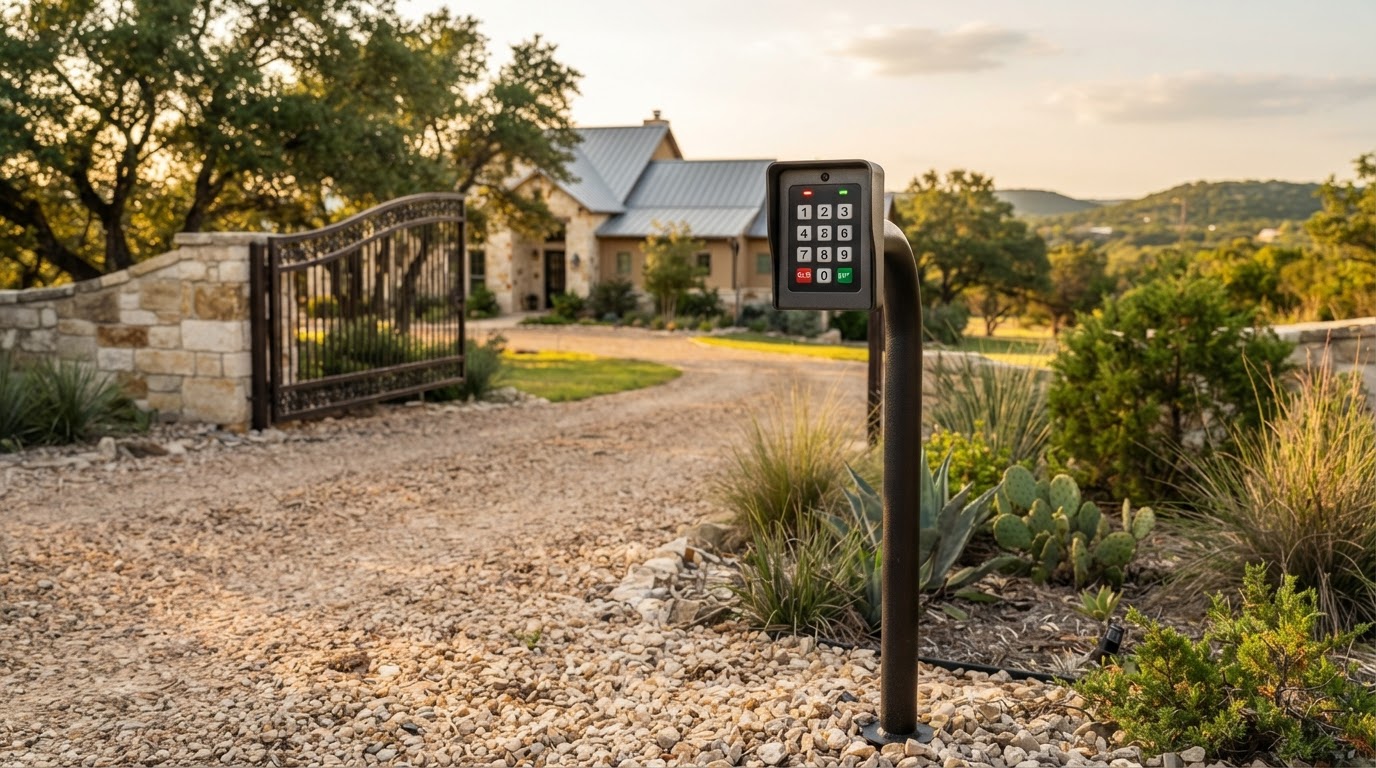
Most keypad complaints come from a keypad in the wrong spot. We place it:
- At driver window height, on a gooseneck post if needed
- Far enough from the gate that a car can stop without blocking the street
- Far enough from the gate that nobody can reach the moving gate while using it
- Where trucks and trailers can reach it as easily as cars
- Facing away from the afternoon sun when possible, so the screen is readable
Gated neighborhoods in San Antonio
If you manage a gate across the entrance to a residential development inside San Antonio, the city has its own rules about emergency access.
A City of San Antonio Police Department permit application for gated communities says an access controller may not restrict entry to a residential development without first applying for a restricted entry access permit. It says access must be available through an electronically controlled keypad system or a staffed entrance, with the same emergency access code at every keypad entrance, and that permits are valid for one year.
Source: San Antonio Police Department, Permit Application for Gated Communities with Restricted Access Entry
That's for neighborhood entry gates, not most single homes. Other cities and fire departments have their own rules, and some require a Knox key switch so fire crews can open the gate. If your gate serves more than your own home, check with the city and fire department before you change the access system.
Can you add access control to my current opener?
Usually. Most openers have inputs for keypads, receivers, loops, and intercoms. Older openers may need a new receiver or a small add-on board. If your opener is too old to work with modern devices, it may be time for a new gate opener installation. If a keypad or remote stopped working, that's gate opener repair.
How do you keep codes and remotes secure?
A keypad code that's been shared around for years isn't much of a lock. We suggest:
- One code per person or service, so you can delete one without changing the rest
- Changing the main code when you move in or after a worker leaves
- Clearing lost or stolen remotes from the receiver right away
- Using rolling code remotes that are harder to copy
- Reviewing the code list once a year
Access control FAQs
Want better control over who comes in?
Call or send a few details. We'll recommend the right setup for your gate.